Diabetic eye care · Green Bay, Wisconsin
Diabetes affects the small blood vessels of the retina before you'd ever feel it. An annual dilated exam is how changes get caught while they're still most treatable — and your physician gets the findings, too.
What we look for
A diabetic eye exam is a targeted search for the specific ways elevated blood sugar affects the eye — most of which begin silently.
Weakened, leaking or blocked retinal blood vessels — the leading cause of preventable vision loss in working-age adults.
Fluid collecting in the central retina, where your sharpest vision lives — treatable, and far better caught early.
Diabetes can accelerate clouding of the eye's natural lens, often earlier than expected.
People with diabetes carry a higher risk of glaucoma — pressure and optic nerve health are checked at every exam.
Blood sugar fluctuations can shift your prescription noticeably — a clue in the exam room, not just an annoyance.
Year-over-year retinal imaging turns subtle changes into visible ones — before symptoms do.
Imaging with a memory
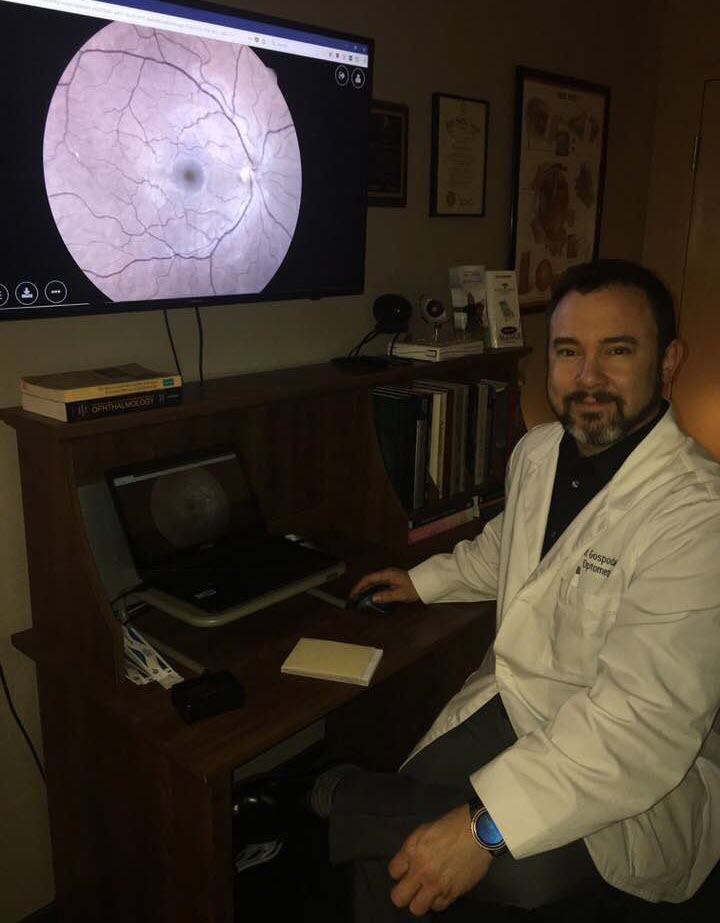
The practice uses the Eidon retinal scanner — ultra-widefield, true-color imaging of the back of your eye. For diabetic care, that matters twice: subtle vessel changes show up in high resolution, and every scan stays on file, so this year is always compared against your own baseline.
And it's the same doctor doing the comparing, every year. Dr. Gospodarek walks you through your images on the big screen in plain language — what's healthy, what's being watched, and what it means for you.
Caught early, retinopathy is manageable. Caught late, it isn't.
Team care
Diabetes care works best when everyone treating you sees the same picture. After your exam, the findings are reported back to your physician — so your primary care provider or endocrinologist has the eye results alongside your A1C.
Exam findings go back to the doctor managing your diabetes, closing the loop on your annual care checklist.
If retinopathy needs treatment, you're referred promptly to a retinal specialist — with your imaging already in hand.
The same optometrist examines you at every visit, so change from your own baseline never slips through.
This is a medical eye exam — glaucoma, cataract and retinal health are all evaluated, not just your glasses prescription.
Common questions
At least once a year for most people with diabetes — more often if changes are found. Yearly exams are the standard of care because retinopathy is most treatable before you notice symptoms.
With type 2 diabetes, at the time of diagnosis — the disease may have been present for years already. With type 1, typically within five years of diagnosis. Either way, yearly exams follow from there.
Yes — that's precisely the point. Early diabetic retinopathy usually has no symptoms at all. By the time vision changes, damage is already underway.
Yes. Findings are reported back to your physician, so the doctor managing your diabetes has the eye findings alongside the rest of your care.
Dilation makes eyes light-sensitive and blurs near vision for a few hours. Many patients drive with sunglasses; if you're unsure how you'll react, bring a driver the first time — and bring sunglasses either way.
Related care
The full picture of your vision and eye health — for every age.
Red, irritated or painful eyes diagnosed and treated on site.
Fittings for daily, toric and multifocal lenses — matched to your eyes.
If it's been more than a year — or you've never had a dilated diabetic exam — book it now. Online in under a minute, or call 920-355-3055.
Book an appointment